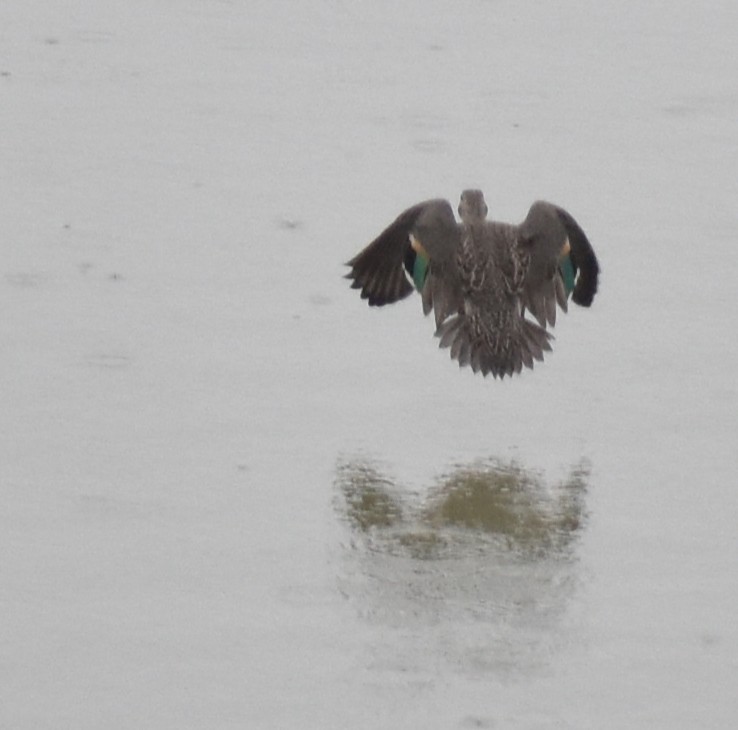
Gone are the days when every duck i observed was a mallard, unless i’m visiting the zoo. Out here in the sloughs, ponds, mudflats, rivers and marshes, the exotic migratory birds are as common as crows.
In the case of the Green-winged teal, I was after a stop-action shot using my Nikon D3500 DSLR. The species didn’t matter necessarily. I assume I’m looking at a mallard but several species were afloat in the slough including the Northern Pintail. Mostly mallards.
I lined up the shot with the telephoto with shutter speed at 1200, Apetture somewhere, and ISO at 25,600. I’m still working on better settings. all that matters to be is the stop action meaning the shutter speed has to be over 1000, who cares about the rest. I got the shot of the teal going away from me.
when I got home I sent a cropped version to my phone and put it through merlin (developed by cornellab). It nailed the id as the green-winged teal by capturing the green on the flap of the wings. I like merlin because you can program the location. That way Merlin will search a finite group. I’m not in madagascar so birds from that region doesn’t apply.
Though I only have the one picture of the green-winged Teal, there is much i learned about it. For one, there is a blue-winged teal. The green-winged teal is a small duck and a game bird that is very difficult for hunters to shoot because it is so fast. It forages in the shallow ponds searching for plant materials and aquatic organisms.
As a migratory bird it arrives here in about august where it will breeds, nests, and care for its ducklings. Then in may the teal is gone, only to return in August.
The color scheme for the male includes a green swatch that runs behind the eyes. that green appears on part of the wing seen in flight. The head is brown. Together the color combination is striking. One last thing is a white vertical stripe on each side by the wing. The exception is a near relative eurasian Male that has a horizontal stripe.

Leave a Reply